A tuxedo vest, or evening waistcoat, should be low-cut, cover the trouser waistband completely and stay buttoned all evening, with or without the jacket. Choose one when you expect to take your jacket off, when the event is in a cool season or a formal venue, or when you are the groom and want one more layer than everyone else.
The three-piece tuxedo is the jacket, trousers and a matching waistcoat. It looks simple, but the waistcoat has more rules than any other part of the outfit, and most of the mistakes people make come from wearing a daytime suit vest with evening clothes. This guide covers how an evening waistcoat differs, how it should fit and how to button it.
Evening waistcoat vs day waistcoat
The biggest difference is the cut of the opening. A suit waistcoat is built to be seen all day under a jacket with a tie; an evening waistcoat is built to frame a bow tie and a stiff or pleated shirt front.
| Feature | Low-cut evening waistcoat | Day (suit) waistcoat |
|---|---|---|
| Opening | Deep U or V that shows most of the shirt front | Higher V that covers most of the shirt and the tie |
| Buttons | Usually three or four, single-breasted, or a double-breasted front | Usually five or six, single-breasted |
| Lapels | Often a shawl or peak lapel, sometimes none | Usually none |
| Color | Black, or matching the tuxedo cloth | Matches the suit, or a contrast for a casual look |
| Worn with | Tuxedo, bow tie, tuxedo shirt | Suit, necktie, dress shirt |
| Bottom edge | Often cut with points that fall over the waistband | Usually straight or slightly pointed |
| Back | Lining fabric, sometimes adjustable | Lining fabric, usually with an adjuster |
A day waistcoat under a tuxedo is the most common error. It hides the shirt front, which is half the point of black tie, and makes the outfit look like a dark suit with a bow tie. If the waistcoat that came with a suit covers your shirt up to the tie knot, leave it with the suit.
How a tuxedo waistcoat should fit
- Length: it must cover the trouser waistband with no shirt showing between them, even when you raise your arms. This is the one non-negotiable rule.
- Chest: close to the body without pulling. Horizontal creases between the buttons mean it is too tight.
- Opening: the top of the opening should sit below the jacket's lapel line, so the waistcoat never peeks out above the jacket's button.
- Back: flat, with no gap at the small of the back when you sit.
- Trouser rise: the trousers need a high enough waist for the waistcoat to overlap them. Low-rise trousers and a waistcoat never work.
Because the waistcoat sits over the waistband, a belt adds bulk and can show as a ridge. Braces (suspenders) are the traditional solution; our guide to suspenders or a belt with a tuxedo explains the options.
How to button it
- Single-breasted with a straight hem: fasten every button except the bottom one, the same rule as a suit waistcoat.
- Single-breasted with pointed fronts cut to close fully: some low-cut evening waistcoats are designed to fasten all the way. If the bottom button pulls the points out of line when fastened, leave it open; if it sits flat, fasten it.
- Double-breasted: fasten all the working buttons. A double-breasted waistcoat is never worn open.
- Jacket on: the jacket button follows its own rule: fasten a one-button jacket standing, unbutton it to sit.
- Jacket off: the waistcoat stays fully buttoned. Unbuttoning it along with the jacket undoes the reason to wear it.
When the three-piece is the right call
- You are the groom. Put the groomsmen in two-piece tuxedos and wear the three-piece yourself. You match, and you are still the one people pick out.
- A long reception. Speeches, dinner, dancing: when the jacket comes off, a waistcoat keeps you looking dressed and stops the shirt from billowing.
- Winter, churches and ballrooms. The extra layer suits cool weather and formal rooms.
- You want to skip the cummerbund. A waistcoat and a cummerbund do the same job of covering the waistband, so you wear one or the other. Our cummerbund vs waistcoat guide compares them.
The three-piece is a poor choice at a hot outdoor summer event. A two-piece tuxedo or a white dinner jacket will keep you much cooler.
Jacket-off etiquette
At a formal black-tie dinner, the jacket stays on until the host or the most senior person at the table takes theirs off. At a wedding, the groom and groomsmen usually take their cue from the couple, often after the first dance. The waistcoat is what makes this moment look intentional: a man in a fitted waistcoat and bow tie looks finished, while a man in a shirt and bow tie alone looks like he has lost his jacket.
Your options with us
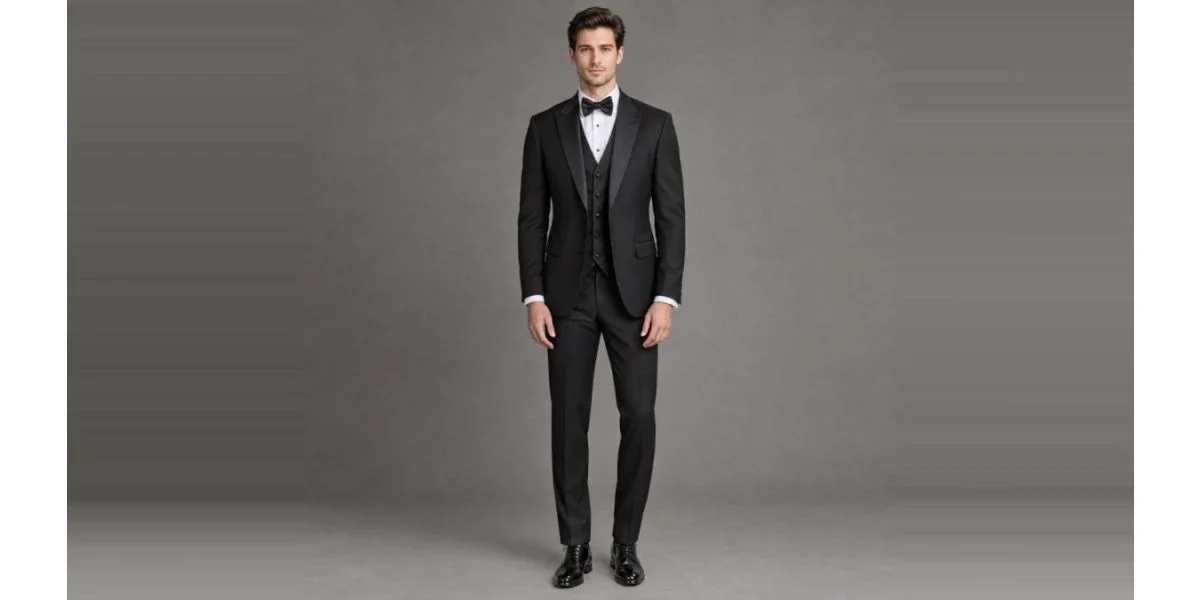
Our Three-Piece Peak Lapel Tuxedo comes as jacket, trousers and a matching low-cut evening waistcoat in black, made to order in a standard size or to your measurements in 2–3 weeks, or 7–10 days with a rush order. The cut is as pictured. If you want to choose the waistcoat's front and pockets yourself, Design Your Own Waistcoat lets you set those details, and the waistcoats collection has single- and double-breasted styles you can wear with suits. Design Your Own trousers also offer brace buttons, which solve the belt problem under a waistcoat.
Questions
Is a tuxedo vest the same as a waistcoat?
Yes. "Vest" is the usual American word and "waistcoat" the British one. For black tie, the garment you want is a low-cut evening waistcoat, whichever name you use.
Can a tuxedo waistcoat be a different color from the jacket?
For traditional black tie, keep it black or matching the tuxedo cloth. A white waistcoat belongs to white tie, and colored waistcoats push the outfit into party wear.
Do I wear a waistcoat with a double-breasted tuxedo?
No. A double-breasted jacket stays buttoned and already covers the waistband, so a waistcoat underneath adds heat and bulk without being seen.